Agentic RAG for Sitefinity: AI Search and Generative CMS
Agentic RAG is Progress’s new AI-powered answer layer. We’ll show you what’s behind it and how it turns Sitefinity into an answer engine – with AI search, generative CMS, and verified answers.
Teile diesen Beitrag:
Teilen Sie diesen Beitrag:
What is Agentic RAG, and how is it related to Sitefinity?
In our last post, we introduced Progress Sitefinity as a hidden champion among enterprise CMS platforms. This time, we’re addressing a question our customers often ask: What’s behind Agentic RAG? And how does it relate to Sitefinity? The answer: More than many people realize. Progress has turned a standalone AI technology into a core Sitefinity feature, elevating the platform to a whole new level. We’ll briefly explain the technology behind it. Above all, though, we’ll show what this means for Sitefinity in concrete terms.
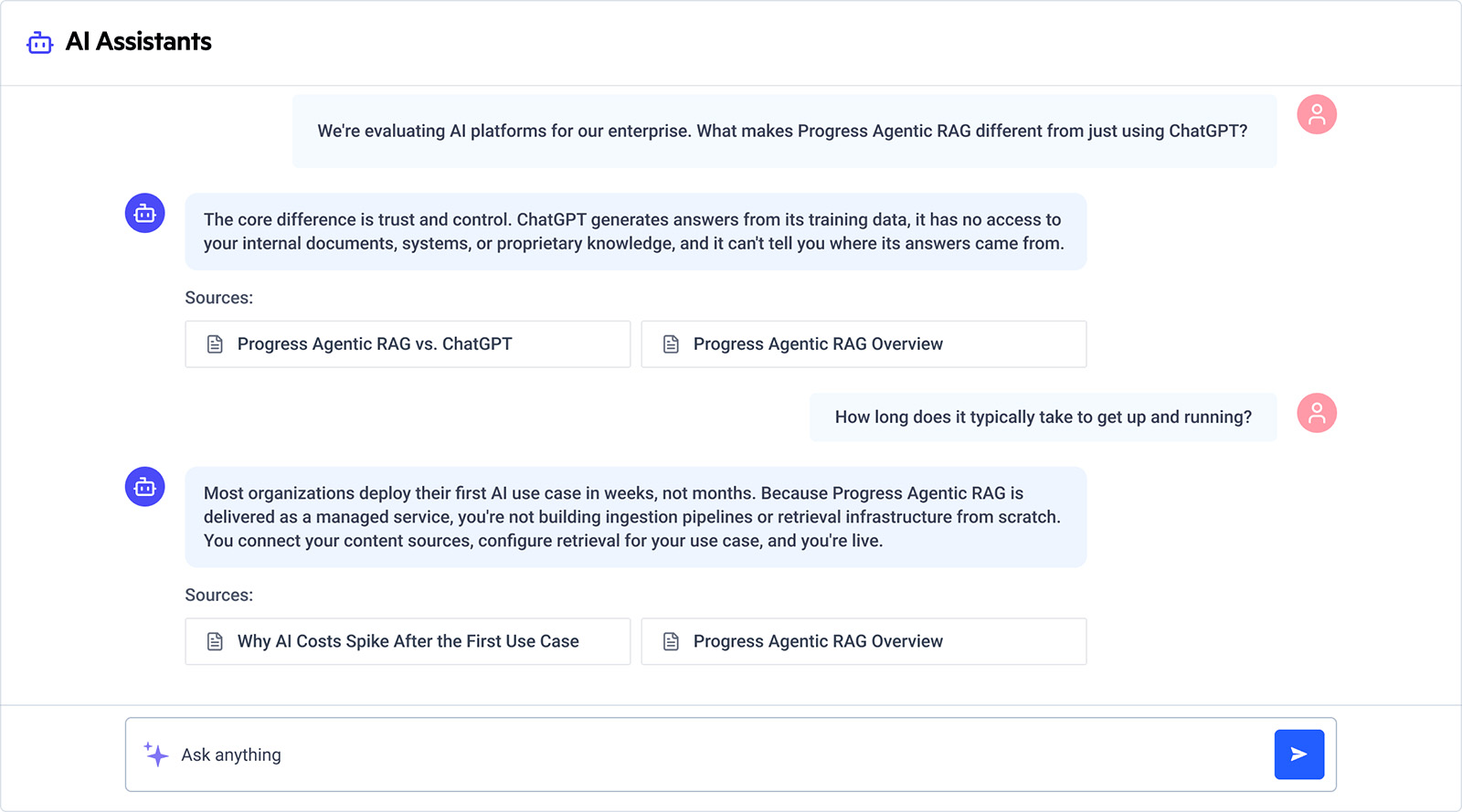
RAG (Retrieval-Augmented Generation) is essentially simple: Instead of generating answers solely from training data, the AI draws on approved, reliable content. It searches for relevant text passages and uses them to create a response, including citations.
Agentic RAG expands on this principle. While traditional RAG performs a one-time search for relevant information, Agentic RAG breaks down complex questions into sub-questions, selects appropriate sources, and refines the search as needed. This results in more precise and better-supported answers with a significantly lower risk of hallucination, since the AI bases its responses on the available content.
Now, let’s talk about the Sitefinity integration, as there’s often a misunderstanding here. Progress Agentic RAG started out as a standalone product, but Progress has turned it into a native Sitefinity product. It’s called “AI Search for Sitefinity CMS, powered by Progress Agentic RAG.” Added to this is the new Generative CMS; both officially operate under the Sitefinity umbrella. So Agentic RAG isn’t just some standalone AI gadget. It’s an integral part of the platform, so you don’t need to change your tech stack to use it.
Classic RAG and Agentic RAG: What’s the Difference?
Traditional RAG follows a fixed pipeline: first, it retrieves information; then, it generates a response. This is sufficient for simple questions, but it quickly reaches its limits when dealing with complex issues. Agentic RAG goes several steps further.
- Question Analysis: The system understands the intent behind the question. It breaks down complex queries into sub-questions.
- Intelligent Source Selection: Retrieval agents automatically determine the appropriate source. This can be Knowledge Boxes, SQL databases, Internet searches, or MCP servers or even several of these at the same time.
- Query Rewriting: Short or unclear queries are refined beforehand. This significantly improves the quality of the results.
- Self-check: Each answer is checked for “groundedness.” This value indicates how closely it aligns with the retrieved content.
In short: Classic RAG provides an answer, while agentic RAG thinks for itself and checks its own work. This ensures it remains reliable even when answering questions that span multiple documents.
Agentic RAG for Sitefinity: How AI Search Works
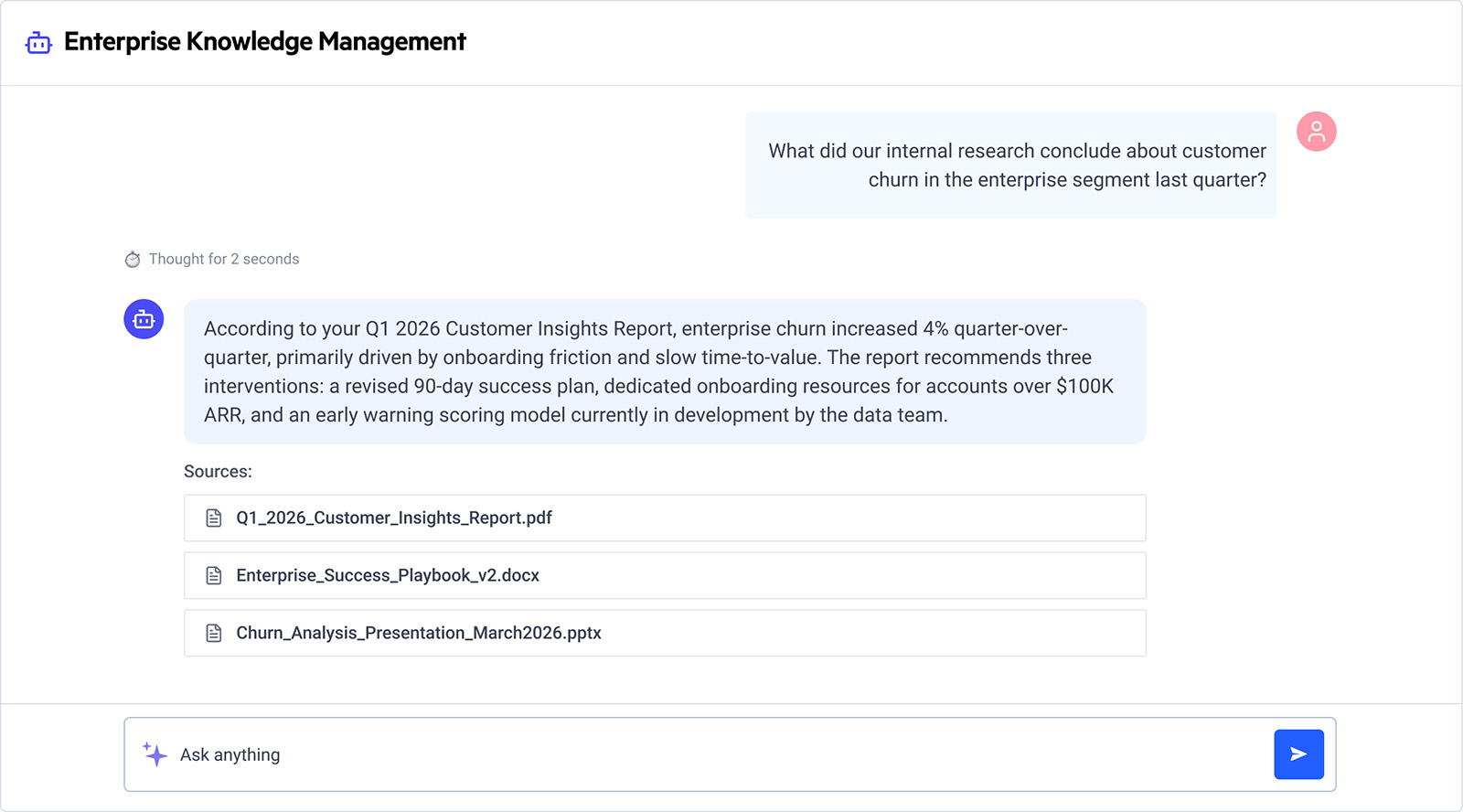
Progress Agentic RAG for Sitefinity consolidates your content and unstructured assets. Everything is stored in a single, controlled knowledge base, and users receive direct, evidence-based answers from it. These answers are delivered through existing Sitefinity experiences, and the process consists of four steps.
1. Ingest: Making Content AI-Ready
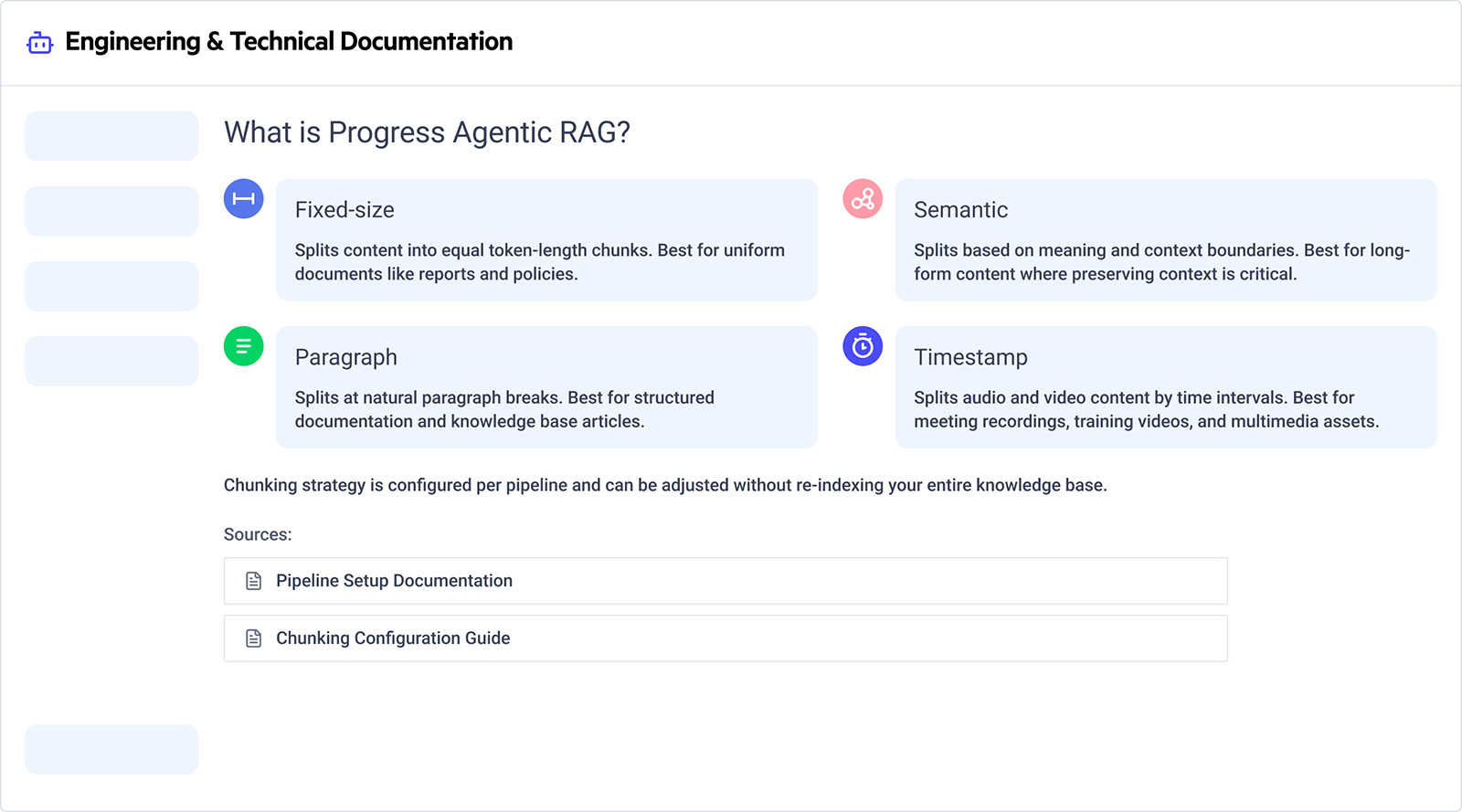
Sitefinity content is indexed along with over 30 other file formats, including PDFs, Word documents, spreadsheets, images, audio, and video. The system automatically enriches the content with tags and consolidates separate silos into a continuously updated knowledge base. Replatforming is not necessary.
2. Retrieve: The Right Strategy for Each Request
For each query, the system selects the appropriate retrieval strategy. Options include semantic search, exact matches, adjacent paragraphs, or knowledge graph jumps. This makes the search suitable for portals, intranets, e-commerce sites, multilingual sites, and regulated industries.
3. Tune: Freely selectable language models
Agentic RAG is LLM-agnostic. You can switch between models such as OpenAI GPT, Anthropic Claude, Google Gemini, or Mistral simply by configuring the settings, no reindexing required. This allows you to maintain control over costs, data privacy, and performance.
4. Validate: Every response must be verifiable
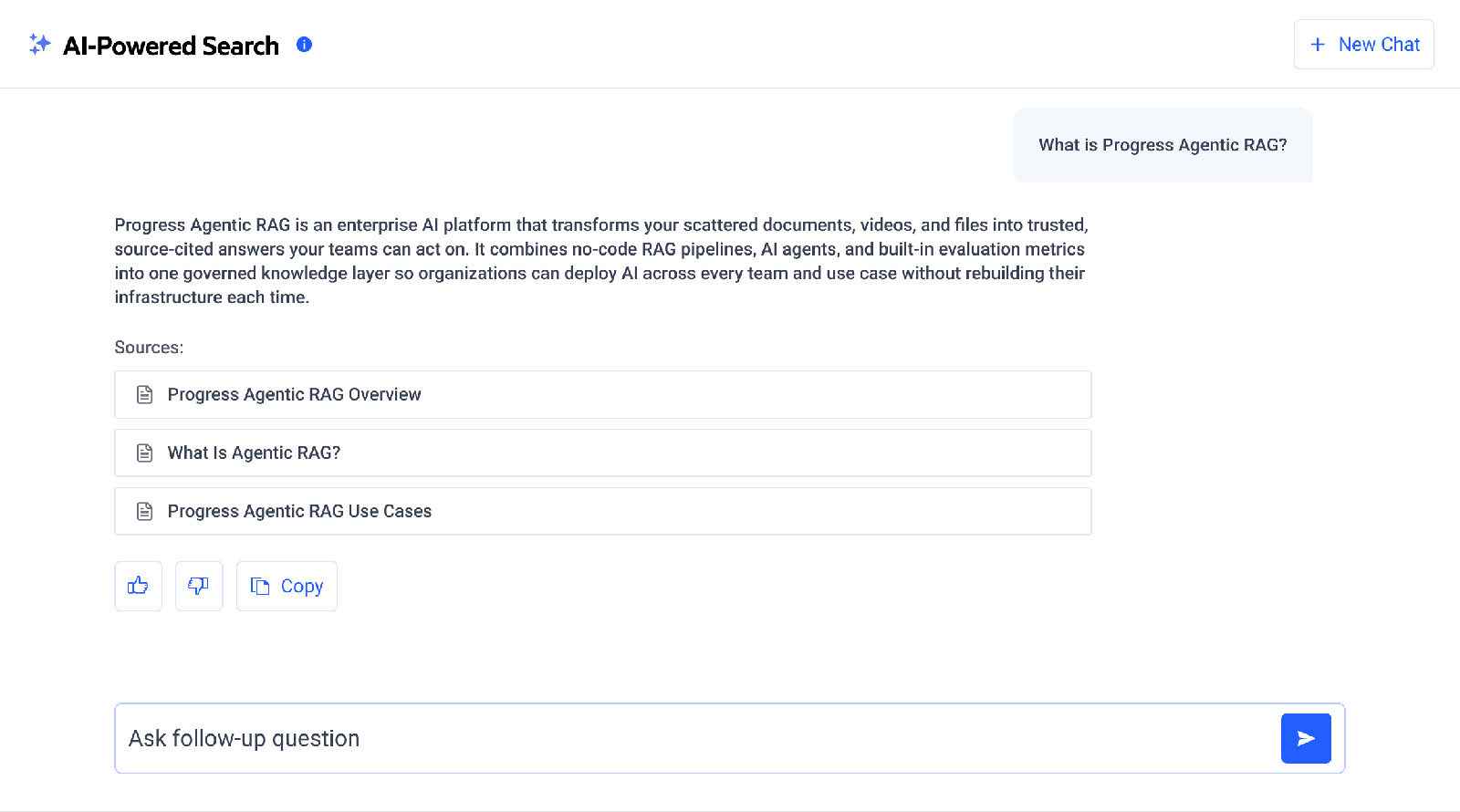
The built-in REMi (RAG Evaluation Metrics Intelligence) engine checks every response. It evaluates three metrics: response relevance, context relevance, and groundedness. If the quality drops, the system triggers an alert. Each response is backed by sources and remains auditable through complete retrieval logs.
Generative CMS: The Next Step Beyond Search
The Generative CMS is set to be truly exciting; Progress calls the combination of Sitefinity and Agentic RAG the industry’s first Generative CMS. An early-access program for it has been running since November 2025. The idea is clear: Instead of static pages, real-time experiences are created and tailored anew for each visitor.
This means users no longer navigate the site in the same way; Sitefinity recognizes their intent and retrieves relevant information. It then dynamically assembles a response, a section, or an entire page based on that information. Profile and behavioral data from the Sitefinity Insight CDP or your CRM provide the foundation. Rule-based personalization becomes intent-based personalization, no one has to manually maintain endless page variations anymore. The experience adapts itself to the target audience, while maintaining brand consistency and governance.
What this achieves in measurable terms
Progress first implemented Agentic RAG on its own website. The site itself is built on Sitefinity. So, in this case, the provider and the user are one and the same. That makes the figures reliable. These figures come from the rollout:
- +29% engagement on the homepage
- 2× longer session duration, up to 27 minutes per session for users with AI search
- +37% conversion rate compared to traditional page search
- Over 7,000 conversation-based queries that revealed users’ true intentions
The last point is particularly valuable from a marketing perspective. You don’t just see what people are searching for; you also see what they’re trying to achieve. This allows you to tailor your content and customer journeys more effectively.
Security, Governance, and Compliance from the Start
In the enterprise and DACH context, trust is the deciding factor in the adoption of AI. Agentic RAG for Sitefinity provides the foundation for this, including permission-aware retrieval. Users see only what they are authorized to see, complemented by role-based access control (RBAC) and end-to-end audit logging. The platform is SOC 2 Type II and ISO 27001 certified and GDPR-compliant. Data is encrypted at rest (AES-256) and in transit (TLS). Every response is derived solely from approved content and is sourced. This significantly reduces the risk of hallucinations. That is the key difference from a standalone chatbot.
Why This Is Crucial for SEO and GEO
Search behavior is changing rapidly. Today, many people get answers through AI assistants and zero-click searches. They no longer even land on a website. It was precisely this trend that prompted Progress to take action. The company wanted to bring the generative search experience back to its own site. It didn’t want to lose traffic and valuable intent data to external AI tools.
For you, this means two things. First, an AI search on your Sitefinity site delivers the conversational experience that users expect. Second, Sitefinity also structures content for Generative Engine Optimization (GEO). This ensures that not only humans but also AI algorithms can find the content. If you want to appear in AI-generated answers, you need clean and verifiable content. Agentic RAG and Sitefinity directly support this.
What this means for your project and how BAYOOTEC can help
As a certified Sitefinity partner, we see the greatest advantage in this combination. You don’t need a separate AI platform, there’s no need for replatforming, and you don’t have to migrate your content either. Agentic RAG builds on the Sitefinity foundation that many companies are already using. You can get started with a phased rollout. First, you validate the quality of responses and the guardrails with a small group of users. Then you scale up. That’s exactly how Progress itself proceeded.
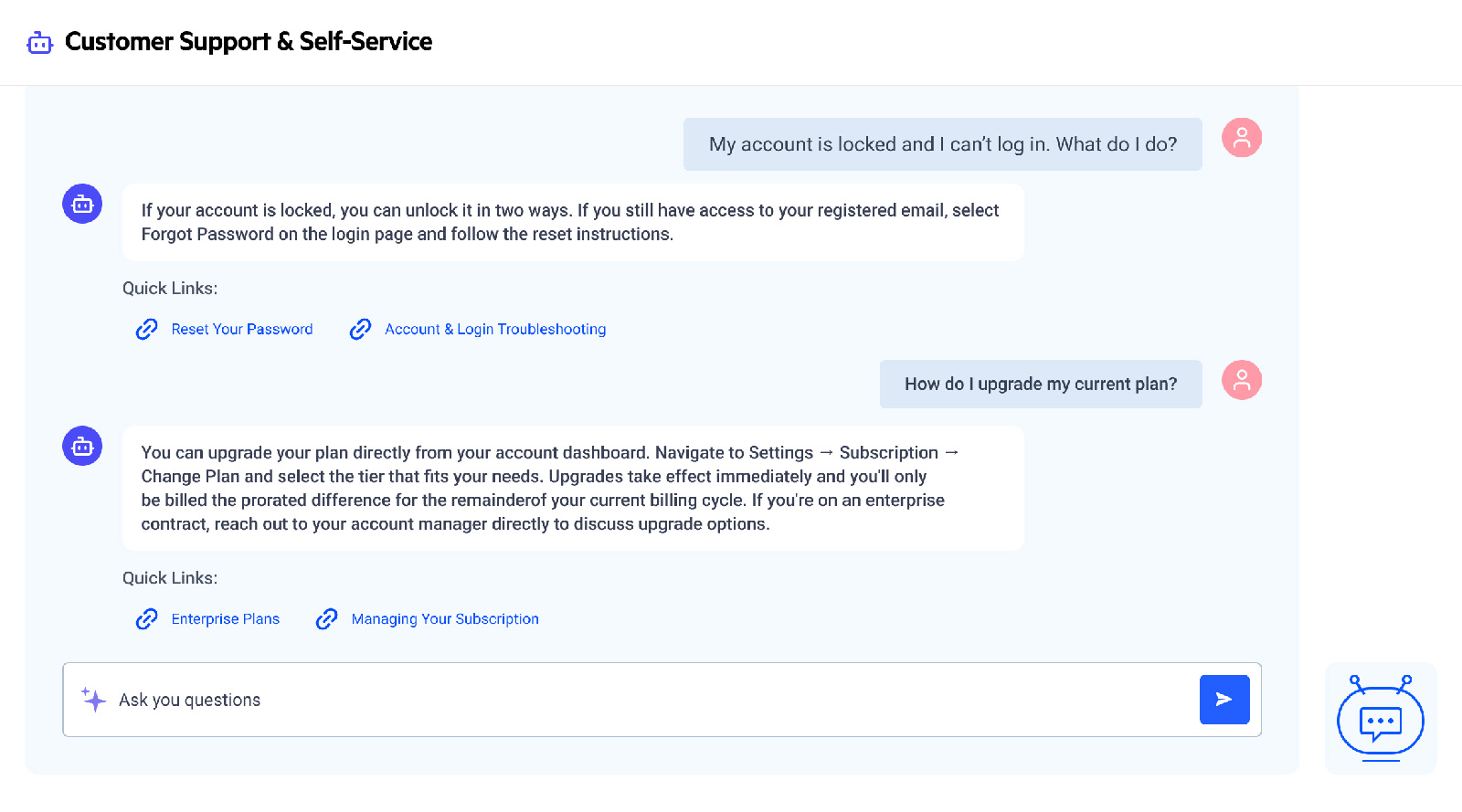
The use case could be an AI search for a customer portal, an intranet with thousands of documents, or your first generative CMS experience. We’ll help you find the right fit. We’ll set up the knowledge base properly. And we’ll factor in governance from the very beginning. Feel free to reach out, together, we’ll figure out what makes sense for your setup.
Want to try Agentic RAG for yourself first? Progress offers a free 14-day trial. With it, you can set up a Knowledge Box and test the search function in just a few minutes.
Conclusion: The “hidden champion” is becoming an AI platform
Agentic RAG is more than just a buzzword. And yes, it’s directly related to Sitefinity. Progress has firmly integrated outstanding AI technology into the platform. A robust enterprise CMS is transformed into an answer engine. It understands, retrieves, and dynamically assembles content. For companies using Sitefinity, this isn’t a fresh start. It’s an upgrade built on the existing foundation. That’s exactly why we at BAYOOTEC are now actively pursuing this topic.