Progress Sitefinity – Why We Rely on This “Hidden Champion” for Our CMS
There are technologies that everyone is talking about, and those that simply work. Progress Sitefinity clearly falls into the second category, and that’s exactly what makes it so valuable to us.
Teile diesen Beitrag:
Teilen Sie diesen Beitrag:
What is Progress Sitefinity, and why isn’t everyone familiar with it?
As a certified Sitefinity partner at BAYOOTEC, we see every day why this content management system is far more than just a solid platform choice. It’s our hidden champion: powerful, easy to integrate, and significantly underrated.
Progress Sitefinity is an enterprise CMS based on Microsoft .NET technology that also functions as a full-fledged Digital Experience Platform (DXP)—developed and operated by Progress Software. The company has been active in the software industry for over 40 years and has been operating the platform for more than 16 years, with proven recognition in the Gartner Magic Quadrant for Digital Experience Platforms and the Forrester Wave.
So why isn’t everyone familiar with it? Because Progress Sitefinity doesn’t rely on big marketing hype. The platform powers over 12,000 websites across 6 continents, including some truly impressive sites like the WHO, a global audience of over one billion users in more than 20 languages, and a vibrant developer community of over 5,000 members. These aren’t the numbers of a niche solution – this is a mature enterprise platform that simply prefers to stand out through quality rather than volume.
Developer Experience: Why Our Developers Value Sitefinity
Anyone who has ever worked with a CMS that regularly drives developers to despair knows how valuable a good developer experience (DX) is. With Sitefinity, the approach is fundamentally different.
The platform is based on Microsoft .NET technology and offers a modern, three-tier architecture with a clear separation between content management and presentation. In practical terms, this means that the front end and back end can be developed, tested, and deployed independently of one another. For developers, this is a significant advantage: no more fumbling around in monolithic structures, and no unintended side effects when customizing the user interface. In addition, Sitefinity itself has a highly modular design, making it easy to swap out individual components.
At its core, Sitefinity is designed according to the principle of dependency inversion and is largely orchestrated through dependency injection. This allows features such as email sending, search, user management, or file storage to be replaced with custom or third-party implementations, enabling the system to be optimally adapted to your specific needs.
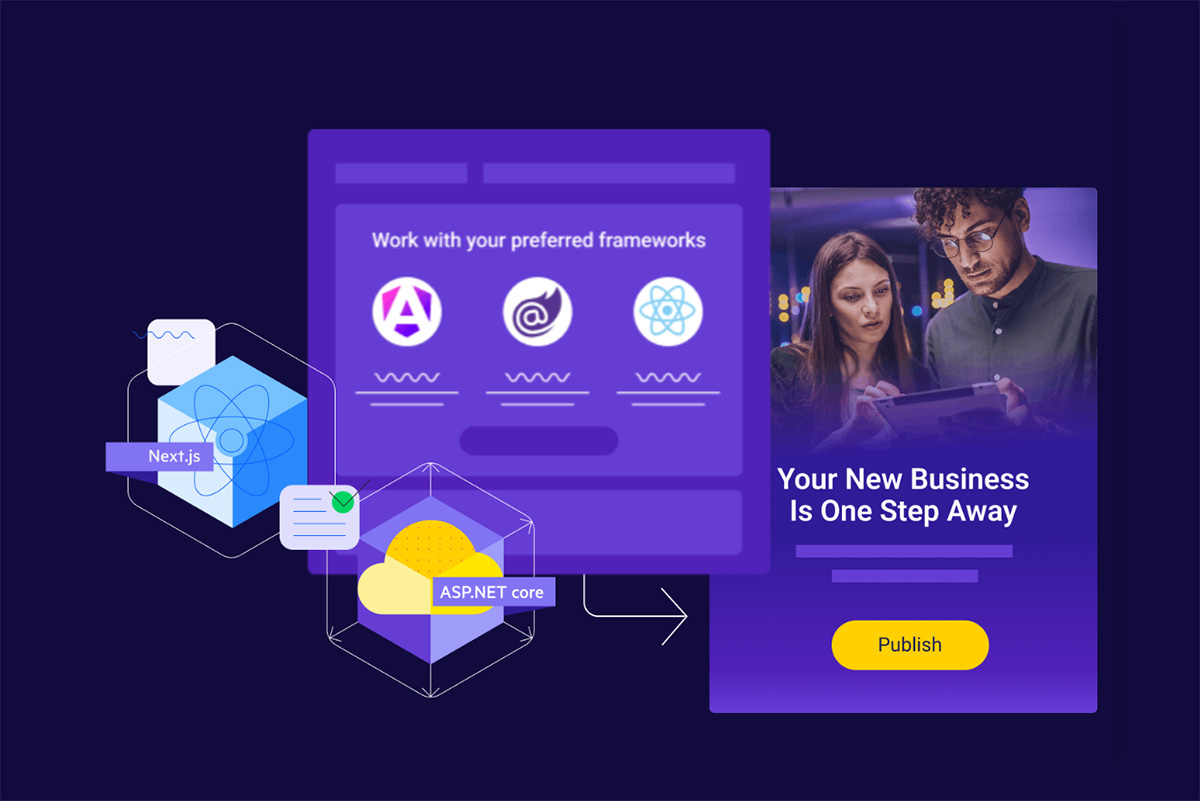
Sitefinity supports popular frameworks such as React, Next.js, Angular, and Blazor, comes with a Visual Studio Extension Package (VSIX), and can be deployed automatically via CI/CD pipelines. A real highlight: Sitefinity provides an official MCP (Model Context Protocol) server, essentially a turbo boost for AI coding assistants in Sitefinity projects. Users can switch to headless or hybrid-headless approaches without having to set up the entire platform from scratch. The Module Builder allows you to create custom content types and dynamic modules without having to delve deep into the code.
In short: Sitefinity is a CMS that doesn’t slow developers down, it speeds them up. This directly translates to shorter development times and, consequently, lower project costs for our customers.
Seamless Integration: Integrations That Really Work
One of the most common problems in complex digital environments is the “silo problem”: CMS here, CRM there, ERP somewhere else, and in between, data gaps, media breaks, and a lot of manual work. Sitefinity is designed from the ground up to prevent this problem from arising.
The platform includes native connectors for a wide range of systems. CRM systems such as Salesforce can be integrated directly, including data synchronization and workflow automation. Marketing automation tools such as Marketo and Eloqua can also be natively integrated. In addition, there is a RESTful API based on the OData protocol as well as GraphQL support, which enables integration with virtually any system.
Many of our customers find the Sitefinity Integration Hub particularly interesting. It’s a low-code/no-code middleware layer that enables connections to over 1,000 MarTech integrations without requiring time-consuming custom development for each new connection. Important to note: According to Progress, the Integration Hub is currently reserved for Sitefinity Cloud or Sitefinity Insight customers.
What surprises many people is that Sitefinity can also be easily integrated with legacy systems. Through API-first approaches, database access, or file-based exchanges such as CSV and XML, Sitefinity can also communicate with older system environments.
SharePoint Integration: Use Documents Where They’re Needed
In many companies, a large portion of the content resides in SharePoint: documents, forms, and internal knowledge bases. The problem is that this content is often difficult to use on external websites because of the system barriers between them.
Sitefinity solves this with native SharePoint integration. Through its connection to Microsoft 365, SharePoint-managed content can be integrated directly into the CMS and displayed on public or semi-public websites—without any disruption in the user experience or the need for duplicate data maintenance. This is particularly relevant for companies with a strong Microsoft infrastructure—and there are a remarkable number of such companies in the DACH region. BAYOOTEC is also a Microsoft Silver Partner, which gives us additional depth within this very ecosystem.
Omnichannel Marketing: Create Once, Deploy Everywhere
Create content and then painstakingly repurpose it for each channel? That’s a model that quickly reaches its limits in practice. Sitefinity consistently follows an omnichannel approach: content is managed centrally and can be delivered across all channels (website, app, portal, digital displays, or other touchpoints).
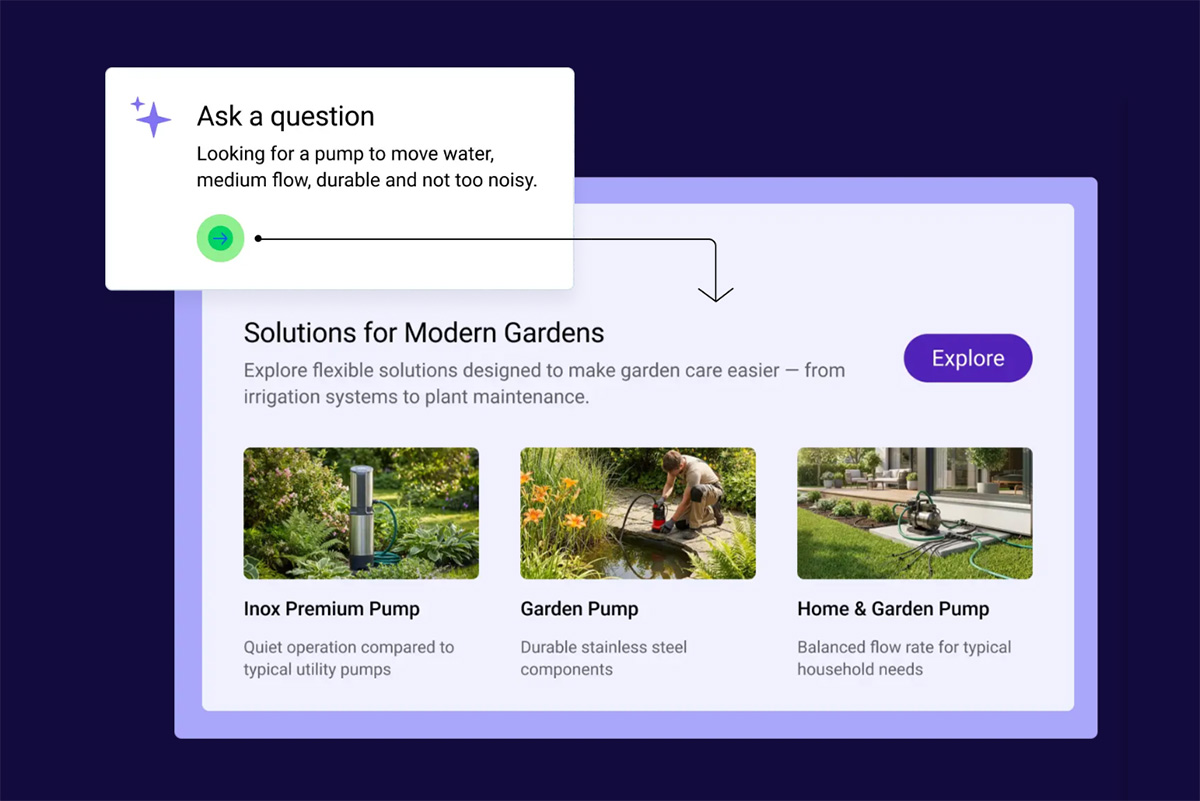
This works because Sitefinity is designed as a headless and hybrid headless CMS. Content is stored in a technology-agnostic manner and delivered to any output channel via APIs. For marketing teams, this means less redundancy, greater consistency, and faster response times to campaigns. Added to this is the Sitefinity Insight Customer Data Platform, which tracks every user interaction, makes campaign performance measurable, enables A/B testing and personalized content delivery, and even suggests specific measures for conversion optimization.
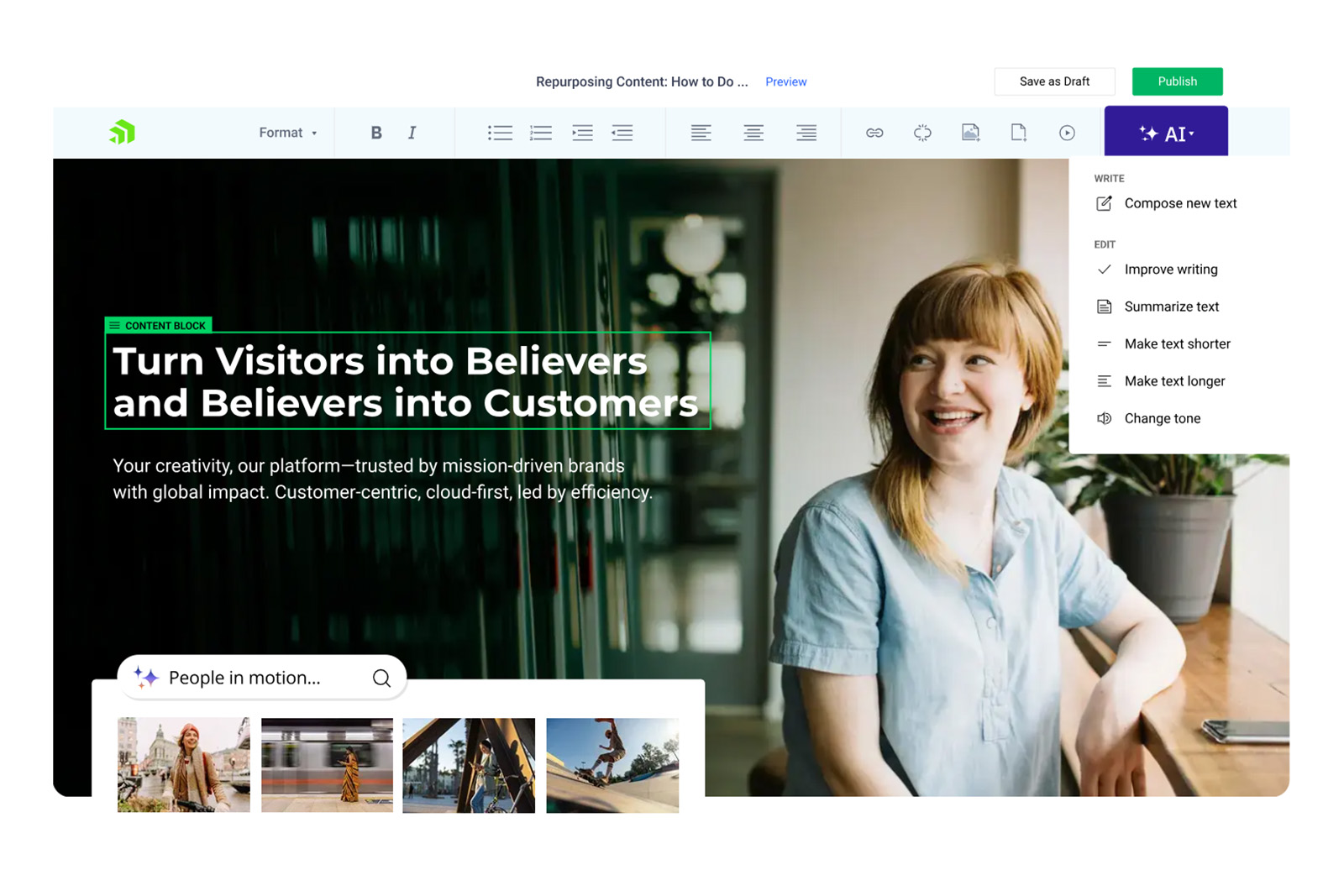
The built-in drag-and-drop page builder ensures that editors and marketing teams don’t have to rely on development resources every time they create new content. They can easily build new pages, landing pages, and content modules on their own.
What this means specifically for projects
At BAYOOTEC, we use Sitefinity in a wide variety of project contexts, and it is precisely this breadth that demonstrates where the platform truly shines.
For Froneri, we developed a corporate website with a B2C section and a direct SAP interface. For SPIE, we created a corporate web hub with an integrated job portal (over 700 job openings), which is also used as an intranet alternative. And for envia Mitteldeutsche Energie AG, we audited, implemented, and deployed a multisite platform on Microsoft Azure.
Security, scalability, and operational stability
Especially in an enterprise context, security and operational stability are not just nice-to-haves, but strict requirements. Sitefinity has a lot to offer in this area: role-based access control, single sign-on capabilities, Azure AD integration, standards-compliant authentication, and a transparent audit trail module. For GDPR-related scenarios, data protection and compliance features are built directly into the platform.
On the operations side, Sitefinity stands out with load balancing, advanced caching, performance diagnostics, and a health check service. The platform can be deployed both on-premises and in the cloud (Azure, AWS, Sitefinity Cloud as a fully managed PaaS), with a guaranteed uptime of 99.95% for the cloud version.
Conclusion: A hidden champion that deserves to be better known
Progress Sitefinity isn’t some insider secret that only works in certain niches. It is a mature, enterprise-ready platform that excels precisely where many other CMS solutions fall short: in developer experience, system integration, operational stability, and flexibility in implementation.
The fact that it isn’t yet as well-known as WordPress or Drupal isn’t due to the quality of the platform, but rather because Sitefinity appeals more to companies with specific requirements and less to those who just want to give it a try. For us at BAYOOTEC, this is why, as a certified partner, we rely specifically on this platform because, in practice, it reliably delivers on its promises.
If you’d like to learn more about how Sitefinity could be used in a specific project, we’d be happy to advise you.