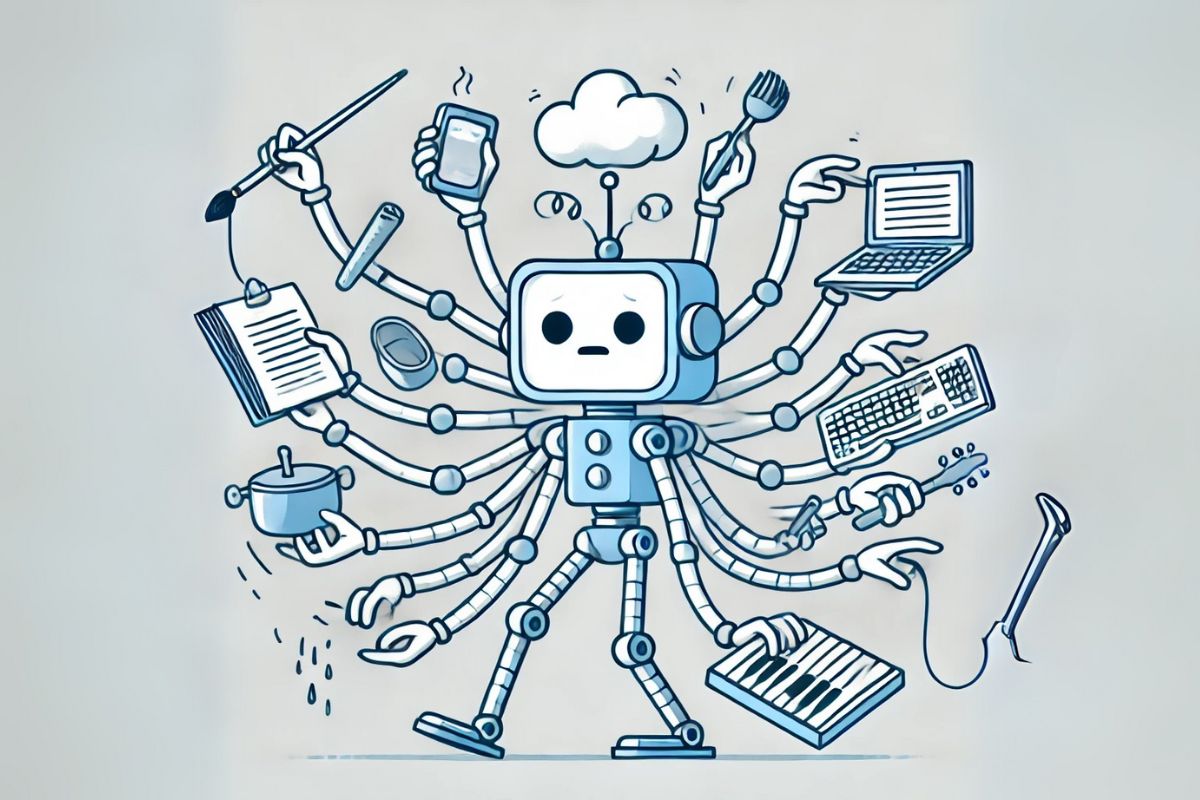
Why specialized AI is the way to go in 2025
In recent years, large language models (LLMs) such as GPT-4 have been the undisputed stars of artificial intelligence. However, since 2024, there have been signs of a clear trend reversal that could become decisive for AI development from 2025: away from universal, huge systems towards smaller, specialized solutions that can be used more efficiently and in a more targeted manner. You can find out exactly what this means in our blog post.
Teile diesen Beitrag:
Teilen Sie diesen Beitrag:
Why smaller is better: the advantages of specialized systems
- Data protection through localization: Smaller systems can often run locally on their own hardware. This means that sensitive data remains secure within the organization without having to be shared via cloud systems. This is becoming increasingly important, especially in industries with strict data protection requirements, such as healthcare or the financial sector.
- Resource conservation and accessibility: Expensive supercomputers are not necessary: Specialized solutions work excellently on consumer hardware. A modern laptop is often enough to efficiently run demanding applications such as text summarization or data analysis. This focus on smaller systems could further drive the democratization of AI, as companies no longer need large budgets for infrastructure.
- Sustainability and energy efficiency: Less computing power also means less energy consumption. In view of growing environmental requirements, this aspect could be one of the biggest drivers for specialized solutions in 2025. Companies are under increasing pressure to use sustainable technologies – specialized AI offers clear advantages here.
What could AI look like in 2025?
Currently, everything points to the fact that we will see a mixture of specialized and multimodal AI by 2025.
- Cross-industry integration: Specialized AI systems that are perfectly tailored to specific industries could create a basis for more efficient work processes. One example of this is systems that help with process automation, for example by analyzing processes in B2B trade or supporting contract negotiations. Such solutions can automatically check compliance with delivery times or create dynamic price recommendations in real time.
- Combining specialization and collaboration: Instead of using a single universal system, companies could deploy specialized solutions in an orchestrated environment where each AI performs its specific task. The concept of an “AI taskforce”, where specialized systems work together efficiently, could become the key to scaling AI solutions.
- Focus on practical solutions: By 2025, there will be an even greater focus on solving specific problems. Universal systems that can do “a little bit of everything” will increasingly be replaced by precise solutions that deliver measurable benefits in areas such as productivity, process optimization and decision-making.
An example of specialized AI
Huge, complex documentation, such as technical manuals or process descriptions – a specialized AI could analyse these documents, structure them and make them interactively accessible. Even better: it allows specific questions to be asked such as: “Which contractual clauses have an impact on delivery times?” or “Which processes could be accelerated through automation?”. These solutions do not have to be able to write poetry or communicate in exotic languages – instead, they focus on their specific task and are particularly good at it.
Further insights
The industry is already starting to rethink. Gartner predicts that specialized AI systems will make up the majority of applications by 2027. IDC also shows that companies are increasingly developing customized AI solutions that meet specific industry requirements and achieve maximum efficiency with fewer resources.
Fazit
Are specialized AIs the future that can drive companies forward? Or will the universal models remain at the helm? Perhaps the current hype will cool down, as it did in the “AI winters” of 1974 and 1987?
The future will show what developments we will see with AI in the coming years. Until then, we are excited to see what new opportunities arise and how we can use them to further optimize our processes.